Showing posts with label Bellingham. Show all posts

Sunday, July 19, 2020

Goin' Home to Powell River, BC


Our Powell Lake float cabin home.
As the Mick Jagger and Rolling Stones lyrics go:
I'm goin' home, I'm goin' home
I'm goin' home, bome, bome ...
Home, bome, bome ...
Back home,
Yes, I am.
Alright!
I bid a short farewell to my loyal Margy Meanders readers. Time has come for Wayne and me to leave for our Powell River Canadian home. We've waited since March to make the move due to strict quarantine requirements. But now is the time since the Canadian quarantine requirement was extended to August 31.

Wayne and I drove to the Pacific Highway crossing in Blaine. Because we became Canadian citizens in 2018 and Powell River is our home, we were allowed to cross the US/Canada border that is closed to non-essential travel for US citizens and other foreign nationals.

BC Ferries recommended that everyone remain in their vehicles.

Rules are in flux right now because of the COVID-19 pandemic, so check with the Canadian Border Service Agency and US Customs and Border Protection before you try to go.

Back in our Hewscraft finally heading up the lake.

We'd hoped to wait until the quarantine requirement was lifted, but decided it was best to go now while there was still some summer left to enjoy our float cabin home up the lake. And there couldn't be a better place to isolate ourselves for the required 14-day quarantine period and beyond if needed.

First Narrows on Powell Lake means we are almost home.

The border crossing was smooth and our BC Ferries connections worked perfectly even without reservations. We left the Bellingham condo (which has been our Washington residence for self-isolation) at 8:12 am after loading the last of the groceries to make it through the quarantine period, and arrived at our cabin deck at 6:15 pm. That's a little longer than normal to make the 260 kilometre (162 mile) trip because we built in extra time for border paperwork and early ferry terminal arrivals.

There's no place like home!

While we are up here in Powell River, there will be little content to share on Margy Meanders. But never fear, we will be back in Bellingham and the States by late September if pandemic conditions allow.

In the meantime, come visit us on the Powell River Books blog for Canadian and off-the-grid stories.

Living through the COVID-19 pandemic has been hard on everyone worldwide. Wayne and I hope you and your family are doing as well as possible during these difficult times. -- Margy

Saturday, July 4, 2020

Exploring Bellingham: Window Hummingbird Feeder


Our condo balcony with a window hummingbird feeder.
In addition to our daily exercise walks, park visits and grocery shopping, Wayne and I are spending a lot of time indoors these days. Probably the same as you.

I miss my garden and visiting critters back home at the float cabin on Powell Lake.

To bring a bit of nature into our living space, I bought a geranium to tend and a hummingbird feeder to watch.


Because our cityfolk condo in Bellingham is on the third floor, I didn't want a hanging feeder that would drip. I researched online and found a model that could sit on a flat surface. I ordered one ffrom Fred Meyer for parking lot pickup. Unfortunately, it wasn't available.

The ant moat with suction cups is on the left, and the feeder insert on the right.

Then I discovered window feeders. The railing around our condo's balcony has a glass insert, so I chose the Juegoal Window Hummingbird Feeder that shipped direct from Amazon.

It's hard to get a closeup with my iPhone through the window.
It comes with an ant moat that attaches to the glass with two suction cups. The feeder lifts out for easy cleaning. I leave it in place to fill to prevent sugar water spills. I haven't needed to fill the ant moat with water, but back home up the lake it was a necessity.

Almost immediately, a hummingbird came to the feeder. Maybe my geranium with bright pink flowers enticed him (or her) all the way up to the third floor.

I've only seen one hummingbird, but he faithfully comes for breakfast, lunch and dinner.

Sitting on the built-in perch enjoying sips of sugar water.

He must be keeping the ready supply of food a secret, unlike what happened back home. Here's a video of a hummingbird feeding frenzy at the float cabin.


Do you have bird feeders? What kinds of birds visit your home?

Tuesday, June 30, 2020

Exploring Bellingham: Zuanich Point Park


Zuanich Point Park in Bellingham, Washington.
There are many parks and trails in Bellingham, Washington. During our stay in town over these pandemic months, we've taken advantage of several. And the good news, there are many more to explore.

We took my car to the Mazda dealer for it's first inspection. We were south of town, so on the way back we decided to visit Zuanich Point Park next to the Squalicum Harbor where we used to keep the Bayliner 2452 that is now in Powell River.


Looking across Bellingham Bay to the Fairhaven neighbourhood.


David checking out the kayaks during the 2011 Ski to Sea race.
Zuanich Point Park is well known as the launch point for the kayak portion of the annual (except this year) Ski to Sea race. We went one year with our good friend David who was visiting from California.

Zuanich Point Park's history is linked to the harbor's development. In the 60s, the Port of Bellingham acquired waterfront parcels for development. Squalicum Harbor was expanded to support industry, fishing and recreational boating. In 1990, an acre was set aside for a kite flying park.

The park was expanded and named Harbor Point Park in 1994. In 1995, it was renamed Zuanich Point Park in honor of retiring Port Commissioner Pete Zuanich, Sr.

The entrance to Squalicum Harbor and the Bellweather Hotel.

Today Zuanich Point Park covers 4.4 acres and includes free parking, the Squalicum Boathouse available to rent, grass for lounging and picnics, paved trails for walking between the recreational and commercial harbours, a nautical themed children's play area, a small dock for water access, and of course, room to fly a kite.

The Anchor Memorial to lost fishermen.
There are two memorials within Zuanich Point Park to honour the fishermen who went to sea and did not return.

The first is large anchor that was moved to the park on dedication day in 1995 as a memorial to fishermen lost at sea between 1943 and 1975. Names on the plaque were supplied by a society of widowed wives.

The park was redesigned and improved in 1998.


"Safe Return" Fishermen's Memorial.
The bronze Fishermen's Memorial statue “Safe Return” was installed and dedicated on Memorial Day in 1999. It overlooks the entrance to Squalicum Harbor.

We walked the park's paths and sat on a bench to enjoy the sun, relax and read. It was also a great spot to people watch. There were walkers, joggers, families on the grass and children playing nearby. It felt good, like we are starting to emerge into a new kind of normal.

You will find Zuanich Point Park at 2600 North Harbor Loop Drive on Bellingham’s waterfront.  Nearby are nautical stores, restaurants and the Bellingham Yacht Club. Dine with a harbour view and watch commercial fishermen tend to their boats.

What kinds of parks are you visiting these days? -- Margy

Thursday, June 25, 2020

Quarantine Cuisine: Strawberry and Rhubarb Crisp


Growing rhubarb in a barrel at the float cabin.
Back at the float cabin I grow rhubarb in a large plastic barrel on the deck. My rhubarb never gets really large, but it was always tasty. My little put usually gave me enough fresh rhubarb for three crisps during the summer months.

Here in the city I had to buy my rhubarb at the store. I order online and do parking lot pickup so I didn't get to pick my stalks. One of the three I got was the largest I've ever seen, but it seemed tender.

Dave, our good friend in Powell River, is a master crisp maker. He gave me his recipe. That's a real friend. But my recipe file is back home so I went back to TasteofHome.com to find a one. Click here if you want to see the video that goes with it.

Strawberry and Rhubarb Crisp

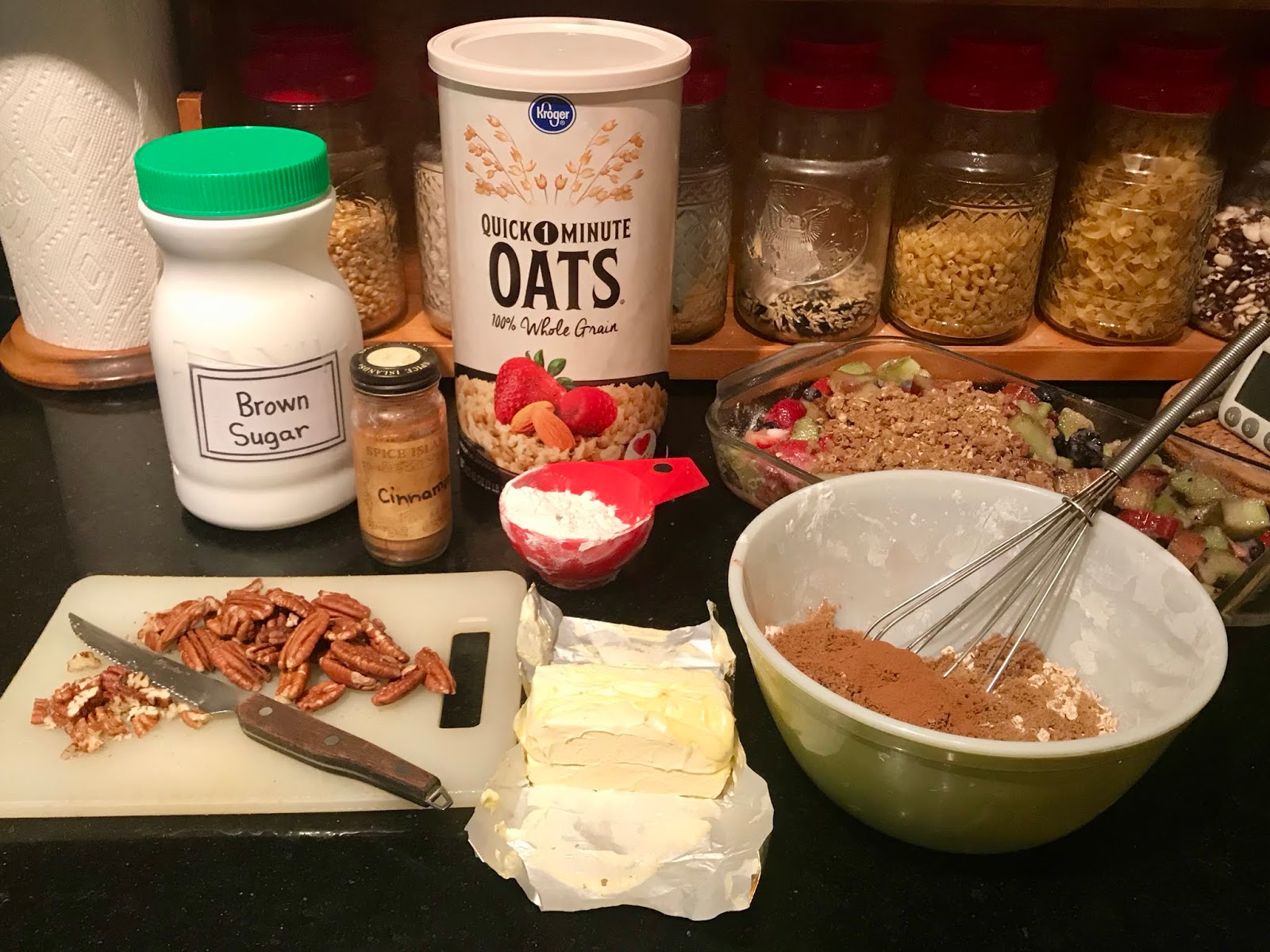
Fruit mixture ingredients.
Ingredients

Fruit Mixture:

3/4 cup sugar
3 tablespoons cornstarch
3 cups sliced fresh rhubarb or frozen rhubarb, thawed
2 cups sliced peeled apples or sliced strawberries


Crisp topping ingredients.
Topping:

1 cup quick-cooking or old-fashioned oats
1/2 cup packed brown sugar
1/2 cup butter, melted
1/3 cup all-purpose flour
1 teaspoon ground cinnamon
Vanilla ice cream, optional

Directions

Clean and cut rhubarb into 1" pieces. Wash and cut strawberries in half. I also had some frozen leftover blueberries and blackberries that I also added to the fruit mixture.

Clean and cut the fruit ingredients.

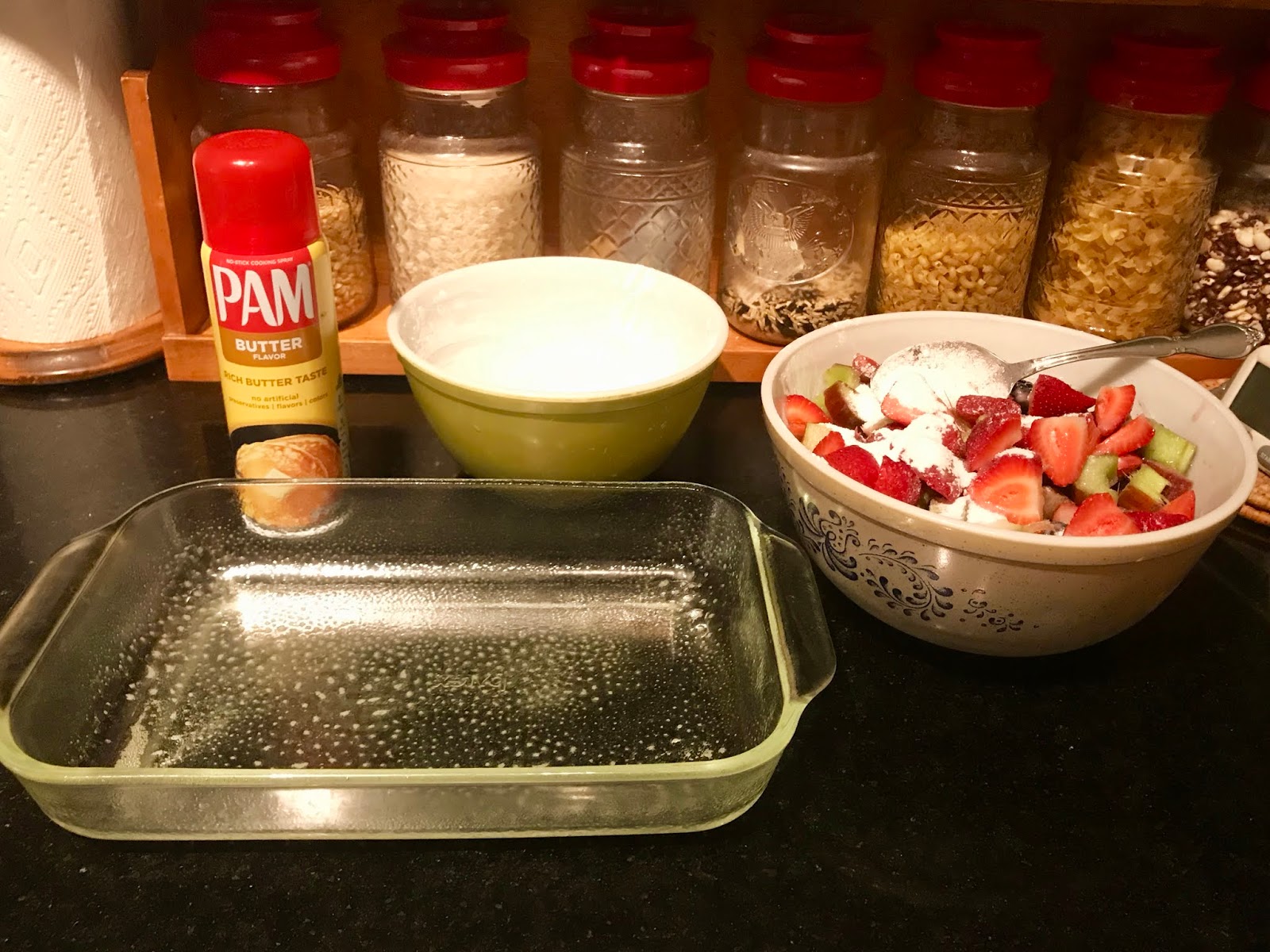
In a large bowl, combine sugar and cornstarch. Add rhubarb and strawberries; toss to coat. Spoon into an 8-in. cast-iron skillet or other ovenproof skillet.

Cornstarch will thicken fruit juices during baking.

In a small bowl, combine the oats, brown sugar, butter, flour and cinnamon until the mixture resembles coarse crumbs. Sprinkle over fruit. Bake at 350° until crisp is bubbly and fruit is tender, about 45 minutes.

Add the topping then bake.


A sweet treat for dessert.
If desired, serve warm with ice cream. It also makes a good breakfast bowl, warm or cold, the following morning.

What have you been making to satisfy your sweet tooth to go with your home cooked meals? -- Margy

Monday, June 22, 2020

Exploring Bellingham: Enjoying Local Parks While Social Distancing


Do you have favourite parks? Here in Bellingham ours is Marine Drive Park. It's small and cozy. We go there often to read and soak up the sun.

A reading "room" with a view.

Other people do, too. They come in cars, on bikes and walking from neighbourhood homes.

Marine Drive Park is family and dog friendly.

There are picnic tables and benches and plenty of lawn to spread out on.

We bring our chairs to enjoy the fresh air and sunshine several times a week.

And an occasional freight train just adds to to the experience.

Burlington Northern-Santa Fe trains haul coal and freight to Vancouver BC.

Where is your favourite place to get outdoors? -- Margy

Monday, June 15, 2020

Exploring Bellingham: Jeckyl and Hyde BBQ and Ale House


It may have a split personality, but it's good eats day and night.
I was hungry for pizza, so Wayne and I went to our go-to spot for some. Whatcom County restaurants just reopened for sit-down dining, but we chose to order ahead and get parking lot takeout.

Tucked away in the corner of a commercial park you'll find a great little restaurant called the Jeckyl and Hyde BBQ and Ale House.

Don't let the modest exterior fool you, there are good drinks and great eats inside.

Outdoor seating is available.
The name hints at a split personality, day and night. No matter what time you choose, there's a welcoming atmosphere, friendly staff and a terrific menu.

In addition to soft drinks, there's beer and wine available. They have bottled beers and several craft brews on tap. My favourite is the Mac and Jacks Amber Ale.

There are plenty of tables inside, and a few outside for warm summer nights and people like us who prefer outdoor seating right now.

A large chalkboard displays their food and drink menu.

In addition to wood-fired pizza, the menu includes soup, salads, sandwiches, and custom made calzones. And that's not all. The BBQ is all stoked up for mouth watering pork and beef brisket. I've had the pulled pork sandwich topped with their homemade sauce, yum! If you have a hankering for a massive amount of good BBQ, check out the Aporkalypse sandwich with pork, bacon and Canadian bacon.

Jeckyl and Hyde BBQ and Ale House
709 Orchard Place
Bellingham, WA 98225
Phone: 360-715-9100

Open Monday-Saturday 10:00-9:00, Closed Sundays
Catering also available.

Stop on by for some really good eats. -- Margy
Sunday, June 7, 2020

Exploring Bellingham: Date Night at Marine Park and Burrito King


A warm evening to enjoy Marine Park in Bellingham, WA.
The last time we visited Marine Park it was back in March during the beginning of the COVID-19 lockdown. It was still technically winter, but there were hints of spring already in evidence.

This week we are well into spring and summer is approaching. Time seems to pass both slowly and extremely fast. Have you been experiencing that sensation?


A sign of the times.
To celebrate Whatcom County's entry into Phase 2 of Washington's Safe Start plan on June 5, Wayne and I decided an evening at the park, soaking up sunshine and reading books on our Kindles was perfect for a date night.

There was a new sign as we entered the grassy field. We set up our chairs with a good view of Bellingham Bay where a huge fishing boat was waiting to enter the harbour to unload its catch.

Several groups came to the park while we were there, but with lot of space distancing was easy. Unfortunately, a few passed a bit too close for comfort, but they kept moving.

Flowers in bloom kept the bees busy.

After an hour enjoying the view and quiet, we heard the whistle of an approaching train. Tracks run between the edge of the park and the bluffs rising from Bellingham Bay.


It was a Burlington Northern BNSF freight train heading south from Canada with a mixed load including telephone poles, boxcars, containers, tankers and ore cars. There were bundles of milled lumber with the Western Forest Products emblem, possibly from our Powell River.

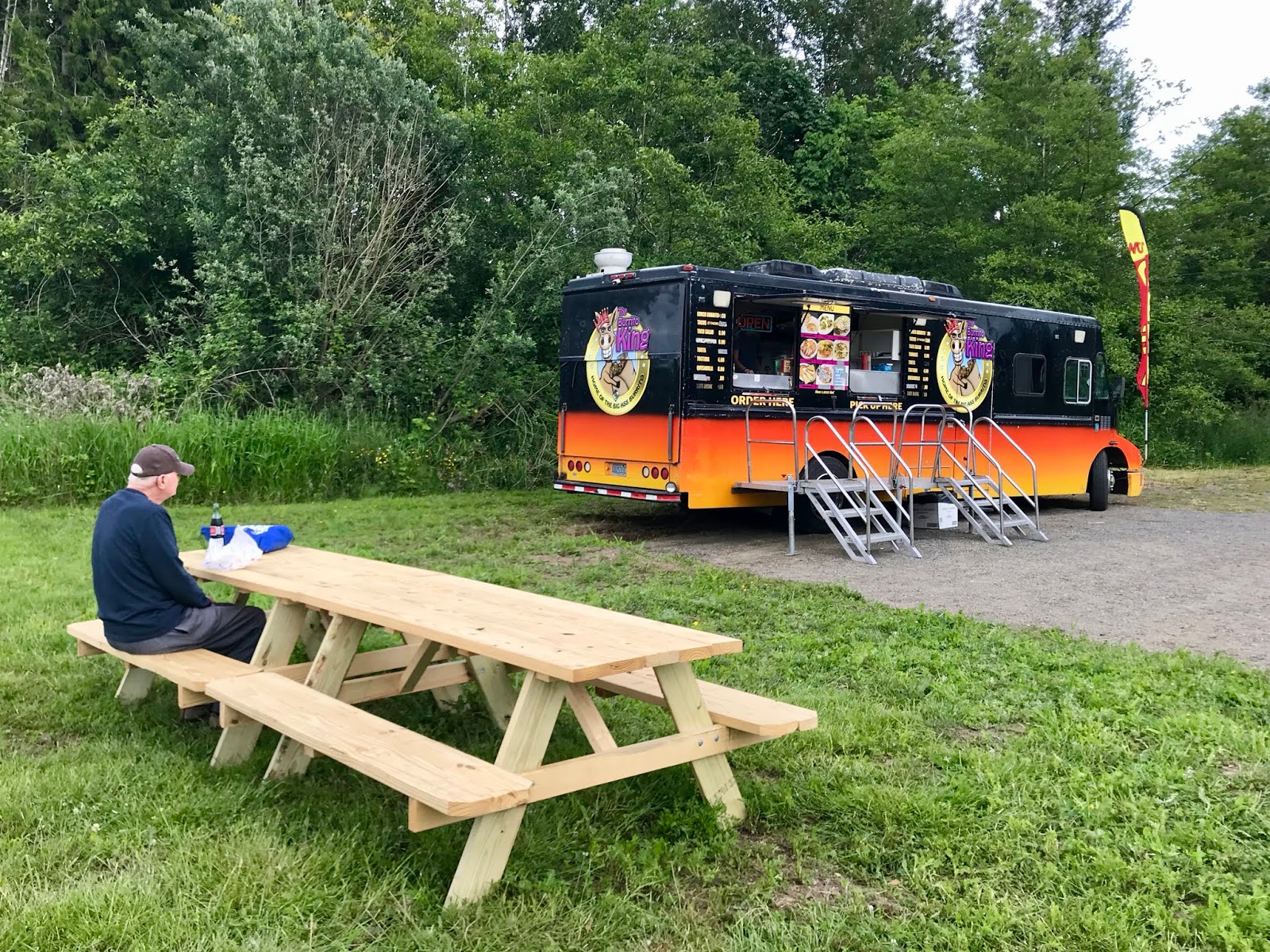
The Burrito King food truck is a welcome addition to our community.

On the way home we decided to go out for dinner. Restaurants are now allowed to have dine-in to 50% capacity. We opted for burritos at the new Burrito King food truck that is parked at Bakerview Road and Eliza Avenue. They've added picnic tables so I hope they are here to stay.

What have you been doing as stay home orders are being relaxed? -- Margy

Sunday, May 24, 2020

Exploring Bellingham: Cottonwood Trees


Tall bare Cottonwood trees in late winter.
This spring I've had the chance to follow the development of plants from their winter bare to their spring bloom. It's been a nice diversion during our isolated life.

Behind our Bellingham condo there are a variety of trees. The largest is the Cottonwood. In fact, the neighbourhood is full of them.

Cottonwoods are a type of poplar, with the same quivering leaves. They grow in moist areas, so the wetlands behind us is a prime spot.

Female catkins on high branches.
Our variety in the Pacific Northwest is the Black Cottonwood.

Male and female flowers are in separate catkins (long, slim clusters) that appear before the leaves each spring.

The female catkin produces the cottony seeds that are blown long distances. It's these fluffy white masses that give the tree its name.


Day one of the seed "explosion."
For weeks now the large green leaves and catkins have been maturing.  A unique fact is that Cottonwood trees are dioecious. This means the male and female flowers develop on separate trees. Growing in large groves increases the chance of fertilization.

Sorry, my closeups aren't the best. I left my camera in the RV in Arizona. We'd planned to return by late March, but that never happened. All I have now is my iPhone's camera.


A grove of Cottonwood trees in an undeveloped area near the Bellis Fair Mall.

For a week now in Bellingham, there have been puffy white seeds floating everywhere from the Cottonwood trees. Here's a short video showing how they fly through the air creating a plant version of a snow storm.


A tall Cottonwood on our walking route.
The seeds are very small (1X4 mm) which is remarkable considering they can grow into one of the largest trees in North America, up to 100 feet (30+ metres) high.

Not only are Cottonwoods large, but fast growing, reaching maturity in 10-30 years. Young trees can add an amazing six feet per year.

Historically, their trunks were used by Native Americans to make dugout canoes. As a commercial product, their course wood is best suited for making pulpwood in the paper industry, pallets and shipping crates.

As summer changes to fall, the leaves turn bright yellow and orange, making a warm contrast to the cooling blue skies.

Here's a look at my Cottonwood trees through the seasons.

Cottonwood trees through the seasons: winter, spring, summer and fall.

What kinds of trees are common where you live? -- Margy

Saturday, May 16, 2020

Exploring Bellingham: Pileated Woodpecker


Dead trees provide homes, nesting places and food for birds.
We're "staying home" at our condo in the States. Mom moved here from California in 2005 to be closer to us. Now it's ours. While it isn't as close to nature as our cabin, we have the creek behind our building with trees and bushes for birds. 

I was on the sofa and heard a strange sound. I saw small objects flying through the air and traced them back to a Pileated Woodpecker drilling into a dead tree. The more he pecked, the more the wood chips flew.

I knew it was a Pileated Woodpecker by its large size, black colouring and distinctive red topknot. They're common in our area, but it's the first I've seen.

The woodpecker was drilling for his dinner, not making a nest hole.

After he worked for a while, he stuck his head inside a nearby hole. He obviously was gobbling up some ants or insects he had dislodged and sent scurrying into his makeshift bowl. Yum!

Eating the "fruits" of his labour.

This was a good example of how you can find nature in your own backyard. Go see what you can find in yours. If you have children, it makes a wonderful learning experience. I have so many fond memories of exploring nature with Mom and Dad. I remember many of the things I learned to this day and it's probably why I love float cabin living so much. -- Margy

Sunday, May 10, 2020

Exploring Bellingham: Field Horsetail


Field Horsetail showing it's segmented sections.
Staying in Bellingham through spring has been exciting. We've had our condo for fifteen years, ever since we retired from our education careers in Los Angeles. Yet, we haven't been here for such an extended period during spring.

Our daily walks have let us watch the native plants in natural areas mature. I've photographed a few as they've developed.


Field Horsetail

I took botany in college.  I loved drawing Horsetail in my lab journal. It looked so primitive. That makes sense, it is considered a "living fossil." The genus is over 300 million years old and was prevalent in Paleozoic forests. Some varieties grew to 30 metres tall.

Horsetail emerges in spring from underground rhizomes.
Field Horsetail (Equisetum arvense) grows in moist spots along streams, sandy places, disturbed or open areas and shady forests. It's considered a weed when located in agricultural and landscaped areas, and it can be poisonous if grazing animals eat it in large quantities.

Their deep, interconnected rhizomes (root structure) make them difficult to eradicate.  But in natural settings, they provide a bright green, wispy ground cover.


The thick fertile stems emerge first.
The perennial underground rhizome sends up both fertile and non-fertile stems in spring.

The pale, thick fertile stems poke up first. They have a cone-like, spore-producing structure on top of a non-branching stem. Horsetails reproduce using spores, not seeds.

Non-fertile green stems emerge shortly thereafter. As they continue to grow, the fertile stems die back and disappear under the new bright green growth.


The green non-fertile stems are photosynthetic. The nutrients produced feed the underground rhizome and allow it to survive through winter.

The green non-fertile stems are taking over from the pale fertile ones.

Horsetails incorporate silica in their cell structure, more than most vascular plants.

The stem segments make it look like a horse's tail.

Around a central cavity, the stem is segmented with whorls of fleshy, needle-like leaves at each junction. This makes it look much like the structure of a horse's tail.

Stages of growth: Fertile stems, emerging non-fertile and maturing Horsetails.

Young Horsetail shoots were used in traditional Japanese and First Nation cultures. There are some applications in modern times, but caution must be taken. Do you have a favourite plant from the forest or fields? Tell us about it. -- Margy